
Are you Gifted?
And what does it mean to be gifted?

Did you know that there are at least two very different ways of seeing giftedness? The most popular, and pervasive, way includes grade-getting, being a good and cooperative student, and having a successful career, e.g. it is prestigious and makes a lot of money. There’s another group, though, that includes me … and always has … and it’s about the “how they be, intrinsic qualities of the highly intelligent being and how they learn, do, see things, and simply are.”

Until recently, I thought what I think is gifted is simply correct and people who saw it differently were wrong.
I was sure I knew the correct answer. I personally thought that it was an inner quality, a form of intelligence that is different, more intense, and noticeable in how some people are. It’s about their essence.
And when I heard people talk about giftedness as being about getting good grades and being a person of high accomplishment, I simply thought they were wrong and that they didn’t understand. For years I held this view. But then, in 2020, I read Maggie Brown’s doctoral dissertation (Research with gifted adults: Mapping the territory using a socially just process.) and learned her Delphi study of experts in the field of gifted education and high intelligence indicates experts fall into at least two camps about what giftedness is. A Delphi study, by the way, is an anonymous series of questionnaires that the lead author narrows down over at least three iterations to focus on what the respondents think about the topic being reviewed.
I am on the side of giftedness being about how someone is, “how they be.” As an example, someone who is very smart and not a good student is usually referred to as “street smart” and not “book smart.” In my mind, it means they are still smart but either didn’t have the opportunity for a good education or didn’t like and cooperate with the way the education was presented. This means that my approach to supporting gifted children and adults is focused on their social, emotional, and mental health, not their career status.
Others just as fervently see giftedness as measured by good grades, good scores, and adult career success measured by earnings and status. Their focus of support is on improving school performance and dealing with underachievement issues. When parents came to me for help with their under-achieving child, I focused on the environment the gifted child is in and whether it is the right one for that child. [I retired from that role in 2017.]
Personally, I think the most common and pervasive view is damaging—and has damaged—way too many highly intelligent people.
So, I think giftedness is complex, hard to describe, and confusing to measure. At the same time, you sort of know it when you encounter it, especially at the very highest levels. But, because of these different viewpoints about what people think giftedness is, many people who are gifted, doubt it. My goals around giftedness and the lifespans of gifted people is to give you all kinds of input and ideas that you can use to figure out this part of yourself. Additionally, I am thinking of those of you are in the role of trying to guide and support others with their own giftedness. The “essence” or “who they be” part of high intelligence doesn’t go away with age. It is part of the entire lifespan. How your environment and you support and increase it over time makes a difference, though. Those ads that encourage you to play their games to stimulate your brain are correct. It does make a difference in your brain activity.
Yes, giftedness is generally about high intelligence.
People generally see it as about the top 10% of a population and then the top 2% to be really gifted, and “off the charts” on intelligence measures, like well into the >99th percentile ranges, to be phenomenally gifted. But measurement instruments vary. What’s tested by them (the IQ tests, for example) or how they are normed, all matter for telling you what you want to know. How you felt when you took the test or if you had access to how to take tests and learned how to do well on them, etc., etc. I’m not going to give you quick answers as much as give you access to many ideas and answers you have about this topic.
What Does Giftedness Look Like in Preschoolers and K-12 students?
I wrote my original Ruf Estimates article as I was gathering anecdotal and test data for my first book, Losing Our Minds: Gifted Children Left Behind (2005) and which was renamed 5 Levels of Gifted: School Issues and Educational Options (2009), both published by Great Potential Press and now Gifted Unlimited, LLC. I started the first book with more than 100 families who either worked directly with me for their children’s evaluations or who knew me through my consulting, speaking or writing. These children were gifted across the gifted range. Even those whose scores were in the same range on modern tests weren’t necessarily all the same intellectually.
Over time, I learned that opportunities in general, and something called “social capital,” greatly impact who shows up for professional help with their gifted children. I learned along the way that there are probably far more people in the gifted range than many people think (sometimes on and off during their own lifetimes for various reasons) and that my Ruf Estimates early milestones for gifted children didn’t have the same predictive powers in some cases as with the people — parents and educators — who already knew what to look for and how to support their children’s intellectual growth. Honestly, though, most readers here are probably in the groups for whom the early milestones are relevant and familiar. And I’ve done statistical analyses of how well they predict eventual IQ test results. They are as reliable as comparing any good IQ test with another good IQ test. About 84% correlation.
So, what if you are already an adult and wonder if you’re gifted?
Believe it or not, most intellectually gifted people (usually identified by school administered IQ tests that are embedded in your achievement tests) are not directly told they are gifted. Sometimes you’ll get the idea the educators know more than you do when they say things like, “You should be getting better grades” or “You can do better than this.” Sometimes you are put in a special class or ability-grouped opportunity, and if you sense or know the other students are smart, and you’re with them, it means you likely are, too.
But not everyone likes school or cooperates during their school years. My second big book is about those original gifted children who are now grown. Their age range in the new book (published the summer of 2023) is early twenties to mid-forties. These are people who mostly understood they were (or are) “supposedly” gifted, although some of them doubted it because they didn’t do well in school or disappointed their parents. I used to recommend you study for and take the Miller Analogies Test, but it’s been discontinued. Instead, sign up for the proctored Mensa test for less than $100. They can’t tell you your score, but they can tell you if you met their 90th percentile acceptance threshold. And, of course, keep reading my material. I’ll share more sources with you a long the way, too.
Another way to know is to listen to what others tell you. Most gifted people simply attract some attention. It usually shows up in how quickly they figure out how to do something compared to others who also trying to learn a new thing. It shows up in humor. It shows up in the segues you bring to the conversations you have. You make connections between and among topics that others can’t do as well. Sometimes you know you’re smart compared to someone else, so when they compliment you for being smart, you doubt they are enough of an authority to tell you that. You’re waiting for someone “official,” right?
And, if you have found me here or on my website and read this far, you are probably gifted or you wouldn’t even be interested in this stuff. PS: I haven’t updated my website in a year and am hoping someone will have interest in maintaining it for me. I will pay for your expertise and time, of course.
Books and Writings by Deborah Ruf, PhD
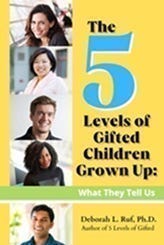
The 5 Levels of Gifted Children Grown Up: What They Tell Us (2023). This is a 20-year longitudinal study follow-up about the original gifted child subjects in 5 Levels of Gifted: School Issues and Educational Options (2005, 2009). In it, Dr. Ruf covers every conceivable topic to ask the 60 of the original study group of 78. She also shows readers how it is that people of the same original promise to succeed have vastly different outcomes. https://www.amazon.com/Levels-Gifted-Children-Grown-Up/dp/B0C9SHFRLH or https://www.barnesandnoble.com/w/the-5-levels-of-gifted-children-grown-up-phd-deborah-l-ruf/1143719859?ean=9798988323709.
5 Levels of Gifted: School Issues and Educational Options in 2009. This is the original 5 Levels of Gifted book for parents and educators. Moderately Gifted, Highly Gifted, Exceptionally Gifted, and Profoundly Gifted children are the subjects of this book (78 of them) and their early milestones, behaviors, and parent journeys through how to raise and educate these children is a must-read. Parents who read this book can estimate their own children’s eventual IQs surprisingly accurately by the time they are age three to about six years old, before it is effective — or reliable — to have them professionally tested.
Here are links to the 5 Levels of Gifted book on Barnes & Noble: https://www.barnesandnoble.com/w/5-levels-of-gifted-deborah-ruf/1126358834 and Amazon: https://www.amazon.com/Levels-Gifted-School-Educational-Options/dp/0910707987 or directly from the publisher: https://www.giftedunlimitedllc.com/store/p12/5_Levels_of_Gifted.html
Keys to Successfully Parenting the Gifted Child (2023). Need answers fast on what to do now? This is a short book — 80 pages including pictures — that is a great starter for parents just wanting some answers … fast! The content was originally from a PowerPoint I created for the parents of gifted children presentations around the country. The contents zero in on some of the most important things about raising gifted children that parents want to know. On Amazon, Keys to Successfully Parenting Gifted Children (2022, 2023) Print and ebook. The Nook version is also now on B&N.
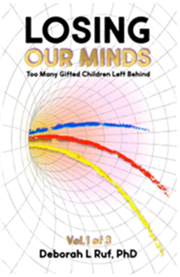
Losing Our Minds: Too Many Gifted Children Left Behind (Oct. 2024). This is the first book in a Trilogy meant especially for educators, parents, adult gifted, and therapists. Questions for discussion are at the end of every chapter. The book provides a detailed analysis of the different levels of giftedness, the concept of “good fit” in educational settings, and the impact of various school environments on gifted children. It also includes personal stories and experiences of gifted children and adults, highlighting the challenges they face in finding appropriate educational and social environments. Available now on both Amazon and B&N. It is not the old purple book from 2005. Also, the Kindle and Nook versions are formatted so readers can click back and forth easily and find their place again. Follow this link: https://www.amazon.com/dp/B0DL3BSC9X or this link: https://www.barnesandnoble.com/w/losing-our-minds-deborah-ruf/1146410968?ean=2940185888872
Environmental, Familial, and Personal Factors That Affect the Self-Actualization of Highly Gifted Adults: Case Studies (D. Ruf, 1998) doctoral dissertation. Free PDF copy: Environmental, Familial, and Personal Factors That Affect The Self-Actualization of Highly Gifted Adults: Case Studies