
Typical Milestones, Interests and Early Behaviors for Levels One and Two Gifted
In the 5 Levels of Giftedness, Part 3 of 6

Early Milestones and Behaviors
Five Levels of Giftedness
The information that follows about Levels of Giftedness is gathered from my own personal experience with families whose gifted children I tested (assessed on ability and achievement tests). The families completed a questionnaire asking them when their child reached various milestones like reading unassisted, or talking in sentences. From the responses of these families, and the corresponding test data, I was able to see a pattern of gifted behaviors for the various Levels of Giftedness. From this same sort of experience and public score reports, estimates of numbers of each Level of Giftedness in different schools were also made.
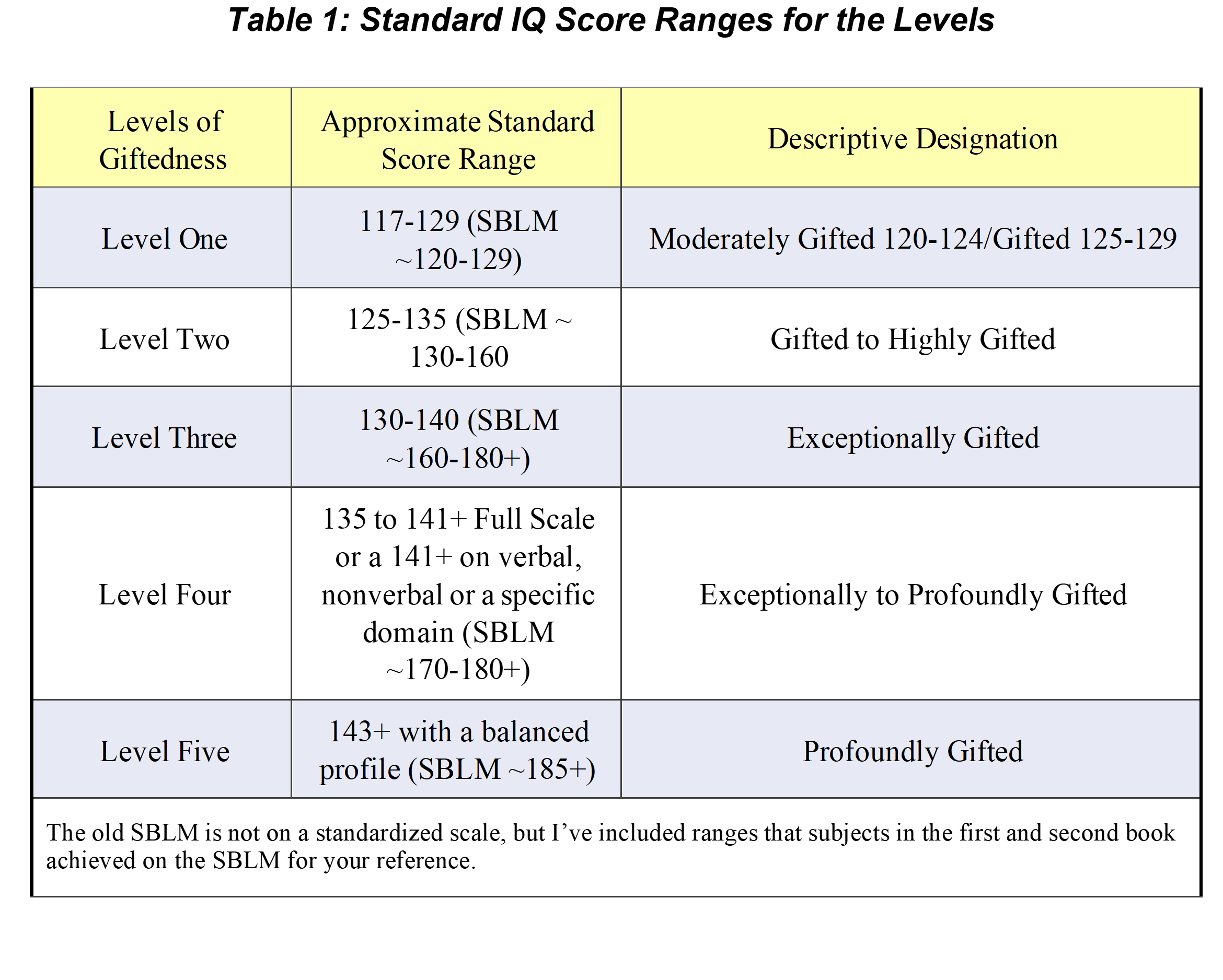
Here is the Score Table to help with deciphering the information. Generally speaking, the Levels are decided by birth to about age 6 in most cases. The less fettered interference of what the children really want to do happens before they start any formal schooling.
Level One Gifted
How many Level One children are there in our schools? The average ability level of different school districts and the schools within them can vary significantly. This will always affect how many gifted children are expected in any school and within any classroom. Children whose abilities are very low (IQs below about 60, in most cases) or mentally delayed are not placed in most classrooms, which raises the average within the school compared to the full population within the school’s attendance area. A typical elementary school 28-student classroom that draws from a generally middle-class socioeconomic community has from 3 to 6 children in the Level One ability range. In public or private schools which draw from mostly a high socioeconomic population — and schools in districts where most of the parents are highly educated professionals — Level One children are average learners and constitute the majority of the students in such schools.
Many recognized colors and could rote count before age two.
· Most knew and said many words before 18 months.
· Many liked puzzles before age two.
· Sat still and attended to TV by 18 to 30 months.
· Real counting, most letters and colors by age three.
· Complex speaking and extensive vocabulary by age three.
· Recognized simple signs, own written name, and most knew alphabet by age four.
· Most did simple addition and subtraction by age four.
· Most showed interest in learning to read before age five.
· All read simple signs and most read beginner books by age six.
· Most were independent on computer and started to keyboard by age six.
· Most fully grasped counting and basic number facts by age six.
· All were reading and were two to three years beyond grade level by age seven.
· All could read chapter books independently by age seven to seven and a half.
· Many showing impatience with repetition and slow pace at school by age seven or eight.
Children of Level One can easily go to college, can benefit from accelerated coursework, and are often, but not necessarily, good and cooperative students.
Level Two Gifted Summary
How many Level Two children are there in our schools? A typical elementary school that draws from a generally middle-class socioeconomic community with 100 children per grade level has at least four to six Level Two children at each grade level, one to two per class. A school with a large number of well-educated families may have more; a school with fewer well-educated parents may have fewer.
