
Giftedness Across Borders
Why People Emigrate, Immigrate, and Migrate for Opportunity


First, why am I writing about this?
I’ve addressed the topic of the “relativity of giftedness” in my blog posts and two of my published books (the ones from 2023 and 2024). I also cover the reality that not all gifted — even the profoundly gifted — get good grades in school. And yet, most people think grades are tightly connected to being smart, e.g. gifted.
Immigration and what’s true and not true about it has been a big deal issue on and off throughout our history. I want to help people see some things that might affect the way they currently see some groups of refugees and immigrants as “better” for the country than other groups. Why do I want to do this? Because every single group has either already advantaged and educated gifted people in it or gifted people who never had a chance for — or access to — education in their countries of origin and they need a chance to find a better life for themselves and their children. It’s possible that an equal portion of those groups have a similar number of gifted people within them, and we know that because people from all walks of life around the globe strive for better education and a chance at financial success. Those success stories are everywhere.
I attended Ohio Wesleyan University from September 1967 to early June 1971. For years I told myself it wasn’t the best place for me, but now I know it was. I make annual contributions and I took the time to read the latest Summer 2026 OWU Magazine. Ohio Wesleyan participates in a program called I Know I Can (IKIC), a nationally recognized nonprofit that empowers—in this case—Columbus, OH, “students to explore and pursue college and career opportunities through individualized advising, innovative programs, scholarships, and grants.” https://www.owu.edu/alumni-family-friends/owu-magazine/summer-2026/
See Teaching Moment for Seeing the Frame. To whet your curiosity, I’ll give you a brief summary.
The subject for the get-together is how we see the world—and how the world is shown to us.
To bring the concept to life, they turned to a familiar figure: Muhammad Ali. Students examined newspaper headlines, radio clips, and media portrayals of Ali across different moments. Some depictions celebrated him as a hero and champion. Others cast him as controversial, even divisive.
“What changed? One student asked.”
“Not always Ali,” a professor replied. “Often it was the frame.”
The lesson centered on the idea of framing—a concept from media and communication studies that explains how information is presented. A frame highlights certain aspects of a story while downplaying or ignoring others. It acts as a mental shortcut, shaping how audiences interpret people, events, and ideas. The media, the class discussed, doesn’t just report reality—it helps construct it.”
I encourage you to read the rest of the one page article.
What Are the Different Kinds of Immigration and Migration?
[This list is from the APSU Writing Center at Austin Peay State University in Clarksville, TN.]
Emigrate: the act of leaving a country to live in another
Emigrate is used when permanently relocating from a home country to a new country.
Example: My parents emigrated from India about 10 years ago.
Example: We are emigrating from Honduras.
Immigrate: the act of entering a country to live
Immigrate means to arrive in a new country after leaving another.
The step after emigration that focuses on where you are going, not where you left.
Example: Our whole family immigrated to Japan for my mother’s job opportunity.
Example: To be closer to his family, he immigrated to Canada.
Hint: You immigrate “into” places. You emigrate “from” places.
Migrate: to temporarily travel to a different place
Migrate is often temporary and often refers to animals that move to different climates when the seasons change.
Example: My grandparents migrate to Florida once the weather gets cold in the Northeast.
Example: After migrating south to Mexico, monarch butterflies hibernate until spring.
Why Do People Come to the United States?
According to the latest statistics, people immigrate to the US to work, reunite with family, study, or seek personal safety. And among those who come for study, they are usually only looking for American universities and sometimes both undergraduate or graduate degrees. We have a much broader range of post-high-school institutions than many other parts of the world. Many educational institutions welcome the usually well-heeled applicants who pay full fare tuitions. Take a look at each of these links about why people come here and what the different classes of immigrant groups are.
https://usafacts.org/articles/why-do-people-immigrate-us/
https://ohss.dhs.gov/topics/immigration/lawful-permanent-residents/immigrant-classes-admission
As part of my adding political and historical perspective to more of my posts — my doctoral degree (Doctor of Philosophy) is officially called The Psychological Foundations of Education — I embark on adding that context to my writings about giftedness. I believe in not only an informed electorate, I believe in grassroots advocacy and involvement that has found some guidance for their actions and proposals. Our educational systems through the PK-12 grade years are “all over the place” in how they deliver education. In many cases, poor showings in state and national achievement statistic are related to lack of access in some areas and some states more than in other areas.
I will also try to draw the connection between this “lack of access to what is needed” for different students to find their “good fit” in school, and the concomitant damage to the mental and emotional health of the gifted children as they grow into adults. Anger, anxiety, hopelessness, etc. shouldn’t be the outcome, but all too often, it is.
Ours is a large and amazing country. In some ways, it isn’t as simple for us as it is for smaller countries whose size and populations are only as big as some of our states. Top-down mandates are easier to defend and operationalize. Yes, it’s complex. But that doesn’t mean we should give up. Trite though it may sound, “Our children are our future.” So much to do, right? Thanks for reading.

References for APSU Writing Center at Austin Peay State University
Betts, J. (2022, May 26). Emigrate vs. Immigrate: A Subtle But Important Difference.
YourDictionary.com. https://www.yourdictionary.com/articles/emigrate-immigrate-difference
Writing Explained. (2023). Emigrate vs. Immigrate: What’s the Difference? Writing Explained.
https://writingexplained.org/immigrate-vs-emigrate-what-are-the-differences-between- immigration-and-emigrationBooks and Writings by Deborah Ruf, PhD
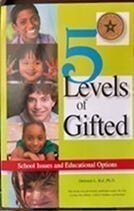
5 Levels of Gifted: School Issues and Educational Options in 2009. This is the original 5 Levels of Gifted book for parents and educators. Moderately Gifted, Highly Gifted, Exceptionally Gifted, and Profoundly Gifted children are the subjects of this book (78 of them) and their early milestones, behaviors, and parent journeys through how to raise and educate these children is a must-read. Parents who read this book can estimate their own children’s eventual IQs surprisingly accurately by the time they are age three to about six years old, before it is effective — or reliable — to have them professionally tested.
Here are links to the 5 Levels of Gifted book on Barnes & Noble: https://www.barnesandnoble.com/w/5-levels-of-gifted-deborah-ruf/1126358834 and Amazon: https://www.amazon.com/Levels-Gifted-School-Educational-Options/dp/0910707987 or directly from the publisher: https://www.giftedunlimitedllc.com/store/p12/5_Levels_of_Gifted.html
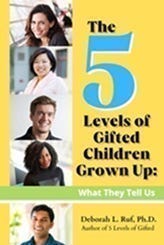
The 5 Levels of Gifted Children Grown Up: What They Tell Us (2023). This is a 20-year longitudinal study follow-up about the original gifted child subjects in 5 Levels of Gifted: School Issues and Educational Options (2005, 2009). In it, Dr. Ruf covers every conceivable topic to ask the 60 of the original study group of 78. She also shows readers how it is that people of the same original promise to succeed have vastly different outcomes. https://www.amazon.com/Levels-Gifted-Children-Grown-Up/dp/B0C9SHFRLH or https://www.barnesandnoble.com/w/the-5-levels-of-gifted-children-grown-up-phd-deborah-l-ruf/1143719859?ean=9798988323709.
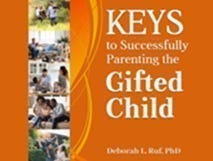
Keys to Successfully Parenting the Gifted Child (2023). Need answers fast on what to do now? This is a short book — 80 pages including pictures — that is a great starter for parents just wanting some answers … fast! The content was originally from a PowerPoint I created for the parents of gifted children presentations around the country. The contents zero in on some of the most important things about raising gifted children that parents want to know. On Amazon, Keys to Successfully Parenting Gifted Children (2022, 2023) Print and ebook. The Nook version is also now on B&N.
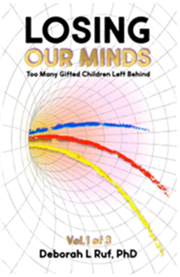
Losing Our Minds: Too Many Gifted Children Left Behind (Oct. 2024). This is the first book in a Trilogy meant especially for educators, parents, adult gifted, and therapists. Questions for discussion are at the end of every chapter. The book provides a detailed analysis of the different levels of giftedness, the concept of “good fit” in educational settings, and the impact of various school environments on gifted children. It also includes personal stories and experiences of gifted children and adults, highlighting the challenges they face in finding appropriate educational and social environments. Available now on both Amazon and B&N. It is not the old purple book from 2005. Also, the Kindle and Nook versions are formatted so readers can click back and forth easily and find their place again. Follow this link: https://www.amazon.com/dp/B0DL3BSC9X or this link: https://www.barnesandnoble.com/w/losing-our-minds-deborah-ruf/1146410968?ean=2940185888872
Environmental, Familial, and Personal Factors That Affect the Self-Actualization of Highly Gifted Adults: Case Studies (D. Ruf, 1998) doctoral dissertation. Free PDF https://dabrowskicenter.org/ruf